Engineering Deans Champion AI as Core Curriculum for All Students
The Future of Engineering Education: Integrating AI and Digital Technologies
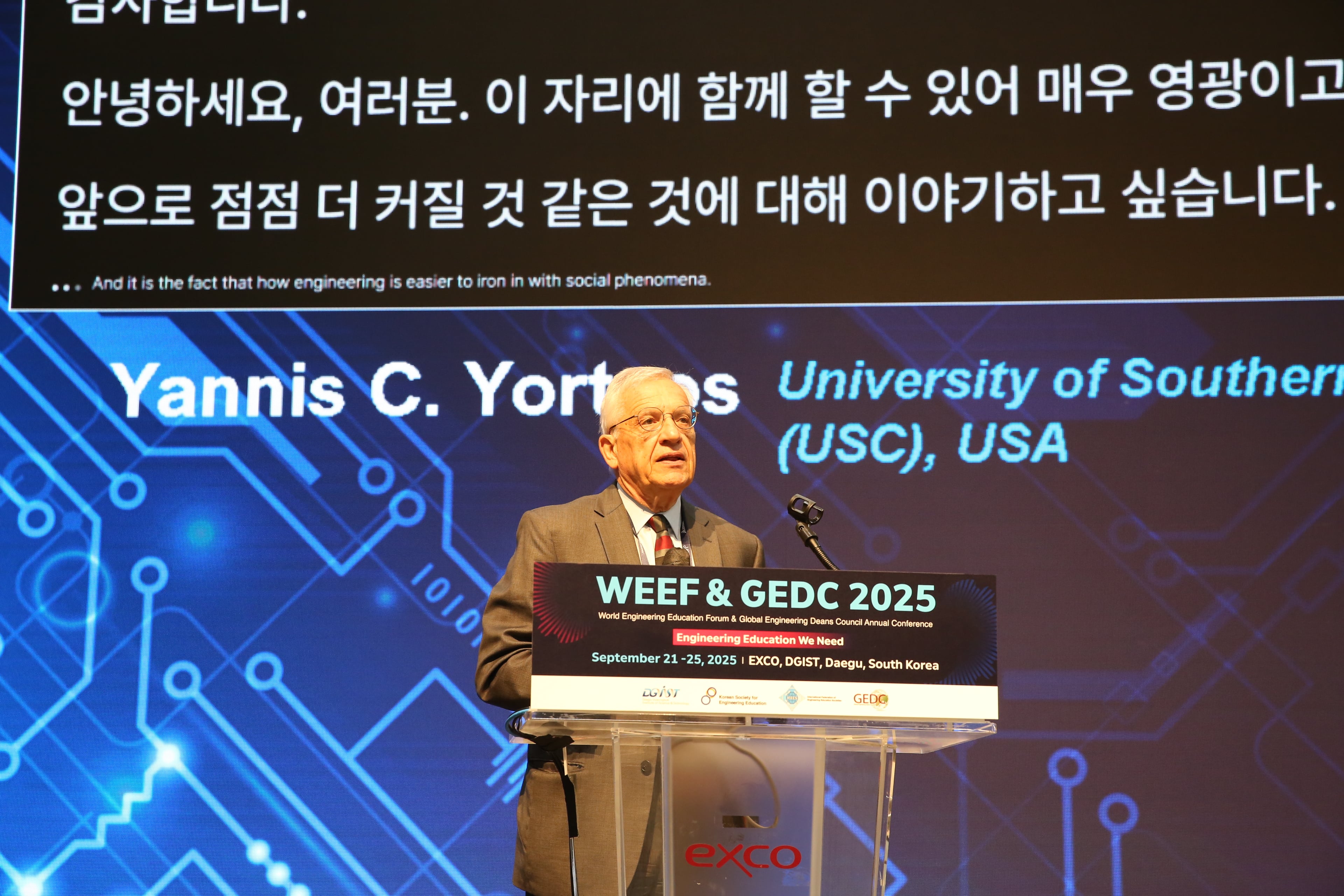
Engineering education is undergoing a significant transformation as institutions worldwide recognize the need to adapt to the rapid advancements in technology. At the recent World Engineering Education Forum and Global Engineering Deans Council (WEEF & GEDC) 2025, held in Daegu, global leaders in engineering education emphasized the importance of integrating artificial intelligence (AI), virtual reality (VR), and augmented reality (AR) into curricula.
Yannis Ortsos, Dean of the University of Southern California Viterbi School of Engineering, highlighted the necessity for all engineering students to learn AI as a foundational subject. “We are now in the ‘AI Plus’ era, where AI significantly impacts all engineering fields,” he said. This shift requires a fundamental change in global engineering curricula to ensure that students understand the basics of machine learning and artificial neural networks.
William Oakes, Associate Dean of Purdue University’s School of Engineering Education, echoed these sentiments. He pointed out that many engineering schools still rely on outdated teaching methods that focus on memorizing mathematical equations from previous generations. “The most critical need in engineering education is to thoroughly teach the foundational principles of AI,” he added.
Embracing Digital Twins and Virtual Technologies
Beyond AI, there was a strong emphasis on utilizing emerging technologies like digital twins in engineering education. A digital twin is a virtual replica of real-world objects or systems, allowing students to conduct experiments without spatial or cost constraints. Paul Gilbert, CEO of Qanser, explained how digital twins can revolutionize classroom learning. “For example, when developing drone swarm control technology, using digital twins enables unlimited experimentation without damaging expensive equipment,” he said.
Kevin Deluzio, Dean of Queen’s University’s Faculty of Engineering and Applied Science, shared similar insights. He noted that digital twin technology can create virtual replicas of large chemical manufacturing plants, enabling students to gain technical experience equivalent to on-site training during their undergraduate studies. This innovation is opening up new opportunities in engineering education that were previously limited by cost and safety concerns.
Cultivating Specialized Talent in AI
As competition in AI technology intensifies, there are growing calls to focus on cultivating specialized talent. Kim Young-o, Dean of Seoul National University College of Engineering, proposed a plan to the South Korean government to select 1,000 top-tier talents—1% of the 100,000 annual engineering and science university freshmen—and provide them with intensive training in AI. “If this process produces innovators capable of changing the world, it will be a worthwhile investment,” he said.
This approach reflects a broader trend among educational institutions to identify and nurture high-potential students who can drive future technological advancements. By focusing on specialized training, universities aim to produce leaders who can address complex global challenges through innovation.
The Role of WEEF & GEDC in Shaping Engineering Education
Established in 2008, the WEEF & GEDC serves as a platform for global engineering schools and industry stakeholders to discuss educational innovations. The event brings together experts from academia, industry, research institutions, and governments to explore ways to nurture next-generation engineering leaders.
This year’s edition, hosted by the Daegu Gyeongbuk Institute of Science and Technology (DGIST), attracted over 800 participants from 50 countries. It marked the second time the event has been held in South Korea, following the 2016 edition hosted by Seoul National University.
Conclusion
The integration of AI and digital technologies into engineering education is not just a trend but a necessity. As the world becomes increasingly reliant on advanced technologies, engineering curricula must evolve to prepare students for the challenges and opportunities of the future. Through innovative approaches such as digital twins, AI education, and specialized talent development, the engineering community is taking significant steps toward creating a more dynamic and effective educational landscape.


Comments
Post a Comment