GIST's Next-Gen Solar Cells Balance Transparency and Efficiency
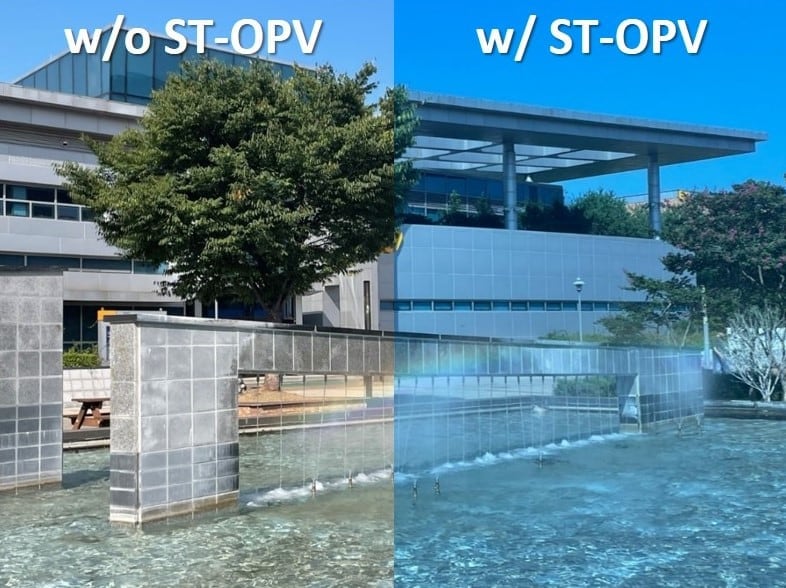

The Gwangju Institute of Science and Technology (GIST) announced on the 23rd that a joint research team led by Kang Honggyu, a senior researcher at the Institute of Next-Generation Energy, and Professor Lee Kwanghee from the Department of Materials Science and Engineering, has developed a core technology to significantly enhance the transparency and power generation efficiency of next-generation semi-transparent organic solar cells.
Semi-transparent organic solar cells are a type of organic solar cell that generates electricity from light, capable of transmitting part of the visible spectrum, making them suitable for use in windows or building exteriors. They can also be applied to building-integrated photovoltaics, vehicle-mounted solar panels, and portable electronic devices.
However, due to the inherent characteristics of the semi-transparent structure, increasing transparency led to a decrease in power generation efficiency, while enhancing efficiency reduced transparency, making it challenging to satisfy both performance metrics simultaneously.
To address this issue, the research team reduced the content of the "electron donor," a material that absorbs visible light, to enhance transparency, and instead introduced an additive that facilitates smooth electrical flow. This additive creates pathways on the electrode surface for current to flow more effectively.
As a result, the team achieved an average visible light transmittance of 37.53% and a power conversion efficiency of 10.7%. The average visible light transmittance indicates how much light in the visible spectrum the solar cell allows to pass through, while the power conversion efficiency represents how effectively it converts solar energy into electrical energy. Additionally, the optical utilization efficiency—a comprehensive evaluation metric calculated by multiplying the average visible light transmittance by the power conversion efficiency—recorded a top-tier level of 4.01%, proving the device’s high performance among semi-transparent organic solar cells under the same conditions.
This achievement presents a new design strategy that secures both transparency and power generation efficiency through a simple device design, without relying on complex multilayer structures as in conventional approaches. It demonstrates that semi-transparent organic solar cells can serve as a next-generation energy technology with practical applications.
Kang Honggyu, the senior researcher, stated, "This study is significant as it resolves the long-standing trade-off between transparency and efficiency in the field of semi-transparent organic solar cells. If integrated with transparent structures such as building windows or vehicle glass, it could greatly contribute to urban energy self-sufficiency in an eco-friendly manner."
The research results were published online in the international academic journal *Journal of Materials Chemistry A* on August 21st and were recognized as a notable achievement, being selected as a Hot Paper.
Reference
Journal of Materials Chemistry A (2025), DOI: https://doi.org/10.1039/D5TA03918E


Comments
Post a Comment