Korea's Military Struggles with Kamikaze Drone Development
The Struggle to Modernize South Korea's Military
South Korea’s military has long faced challenges in maintaining its manpower due to a combination of low birth rates and evolving defense strategies. These issues were first acknowledged as early as 2005 when the Roh Moo-hyun government introduced "Defense Reform 2020." Since then, each successive administration has attempted to address these concerns by introducing new initiatives such as "Defense Reform 2.0" and "Defense Innovation 4.0," which emphasize the use of advanced technology to create a more efficient and capable military force.
However, despite these efforts, the results have been underwhelming. The military has struggled to implement its vision of a "smart military" that relies on automation, drones, and artificial intelligence (AI) to compensate for declining numbers of soldiers. While the Moon Jae-in government took steps to reduce the mandatory service period from 21 to 18 months in 2018, this change was only a temporary measure. The focus remained on modernization, with plans to integrate unmanned combat systems and high-tech equipment into military operations.
One of the most ambitious projects was the development of the "Warrior Platform," a system designed to equip individual soldiers with cutting-edge gear, including advanced helmets, night vision goggles, and real-time battlefield communication networks. This initiative, often referred to as the "Korean Iron Man," aimed to revolutionize ground combat by enhancing soldier capabilities. However, the deployment of this system has been delayed, with only a single unit adopting it so far. Key components, such as personal communication networks and battlefield visualization tools, remain unimplemented due to ongoing development issues.
Experts have pointed out that South Korea lags behind its allies in adopting commercial technology for military use. For instance, the U.S. military has been using Samsung Galaxy devices for combat purposes for over a decade, enabling real-time tracking of troops and drone control. In contrast, South Korean forces are still in the early stages of considering similar technologies.
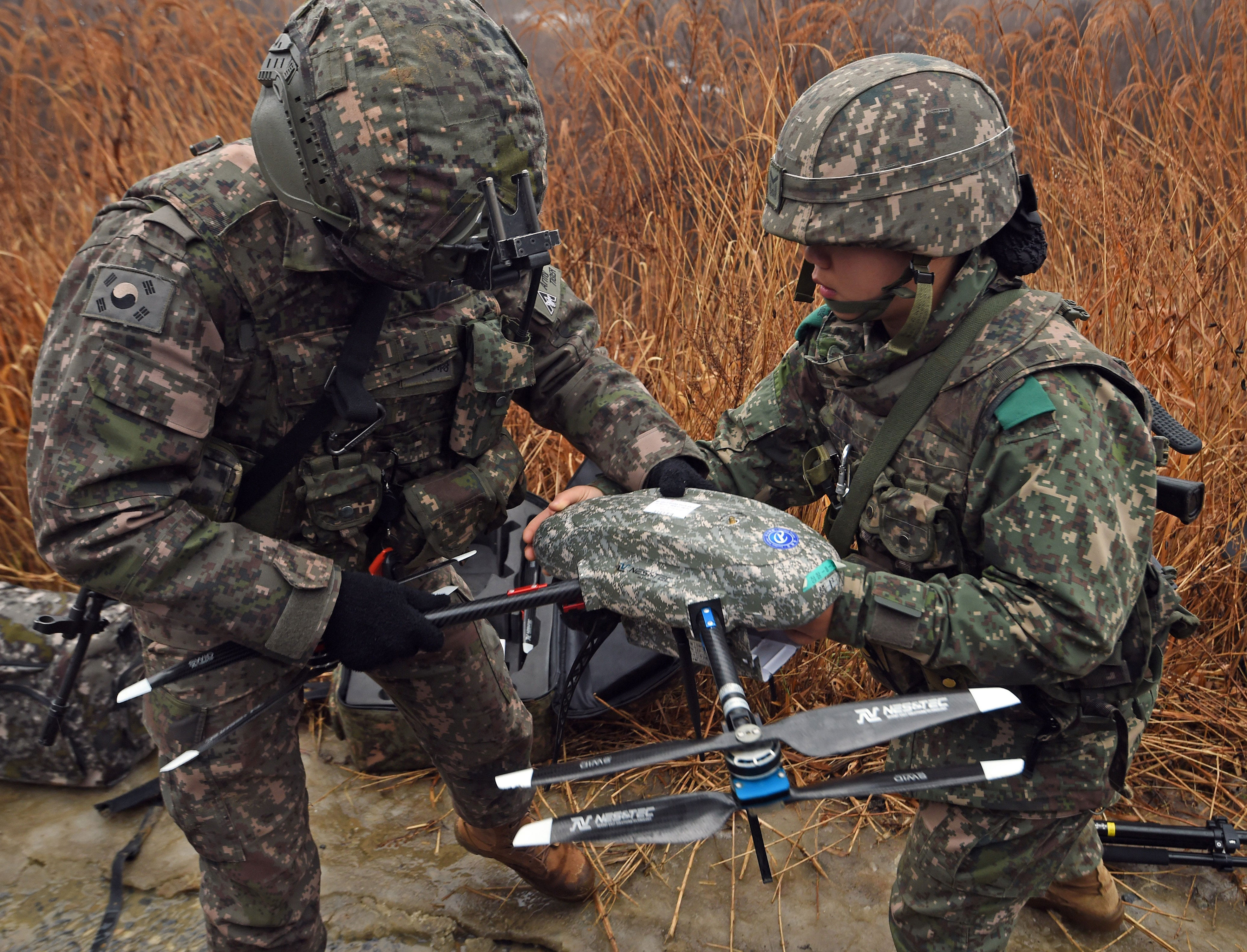
Another major initiative was the introduction of "Dronebot," a concept combining drones and robots to monitor and engage enemy targets. The Army established a Dronebot Combat Unit in the late 2000s, but progress has been slow. It wasn't until last year that the military imported the Polish "Warmate" kamikaze drone, which proved effective in conflicts like the Ukraine war. Domestic development delays forced reliance on foreign imports, highlighting a gap in South Korea’s technological self-sufficiency.
The military also invested in an upgraded "scientized boundary system," an unmanned surveillance network meant to reduce the need for human guards at outposts. Despite improvements, the system still requires constant monitoring, and optical fences often trigger false alarms, leading to missed intrusions. Only limited AI-enhanced thermal imaging systems have been deployed so far, primarily in the 22nd Division.
Unmanned combat vehicles, capable of remote surveillance and firing, have also seen development since 2020. However, disagreements among contractors have stalled the selection process. Meanwhile, countries like the U.S., UK, and China have made significant strides, showcasing advanced unmanned systems in military parades. These vehicles can operate in diverse environments and work alongside manned units via communication networks.
Under the Yoon Suk-yeol government, "Defense Innovation 4.0" has been promoted as a way to leverage AI and robotics for cost-effective and efficient defense. Critics, however, argue that the military lacks the infrastructure and expertise to fully utilize these technologies. Retired officers with advanced degrees in engineering and robotics have expressed frustration with the lack of meaningful implementation. One former lieutenant colonel described the reforms as "empty," noting that billions are spent on modernization without tangible outcomes.
The current system is criticized for not allowing experts to apply their skills or advance in their careers. As a result, many talented individuals have left the military, disillusioned by what they see as a lack of genuine reform.
Despite these challenges, the Ministry of National Defense claims that its reforms are progressing as planned. During the Moon Jae-in administration, it reported an 80% achievement rate for "Defense Reform 2.0," while the Yoon government claimed a 44% success rate for "Defense Innovation 4.0" within a year. However, some military sources argue that these figures are inflated, with easy-to-achieve tasks being highlighted rather than meaningful progress.
The path to a modern, efficient military remains fraught with obstacles, from technological delays to systemic inefficiencies. Without a fundamental shift in approach, South Korea’s military may continue to struggle in its quest to meet the demands of the 21st century.


Comments
Post a Comment