Mistral AI Trails Korean LG, Upstage in Global AI Rankings
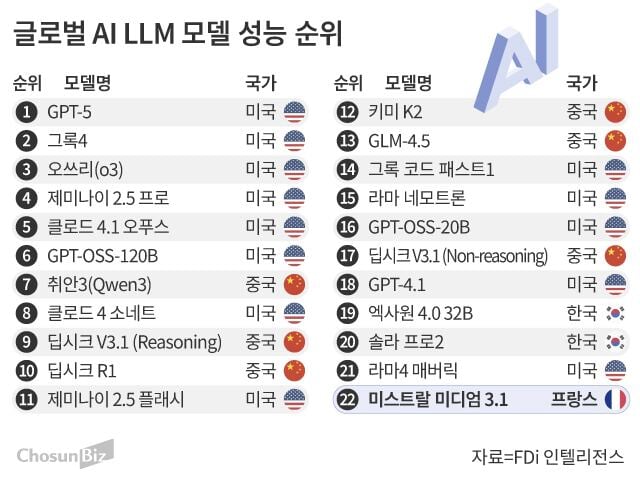
Mistral AI, a leading French artificial intelligence (AI) company, is losing its presence on the global stage. Though the Dutch semiconductor equipment firm ASML has positioned it as a ‘European AI champion’ through large-scale investments, its performance metrics and market leadership trail behind U.S. and Chinese big tech firms. This comes amid a national crisis in France, including a credit rating downgrade and surging government bond yields, which has further shaken the symbolic status of Europe’s representative AI company, according to analysis.
According to industry sources on the 23rd, Mistral gained attention as a ‘dark horse’ in the large language model (LLM) market alongside OpenAI immediately after its founding in 2023. It was frequently mentioned in the same breath as OpenAI, which opened the market with ChatGPT, and attracted rapid global capital inflows with early investors including NVIDIA and Amazon founder Jeff Bezos. Within the industry, it was hailed as the ‘European version of OpenAI’ and emerged as the most-watched emerging AI company.
This attention stemmed from its founding background and strategy. Mistral is a startup established in Paris by researchers from Google and Meta, led by CEO Arthur Mensch. It secured €150 million in seed funding shortly after its founding, rapidly growing into Europe’s largest AI startup by scale. It particularly emphasized model lightweighting and open-source strategies to differentiate itself from U.S. big tech firms that mobilize massive cloud resources. Within Europe, it rose as a symbolic company advocating ‘technological sovereignty’ and secured the trust of global investors.
However, the situation has drastically changed within just two years. The global AI race is now dominated by U.S. big tech firms. OpenAI’s ‘GPT-5,’ Google’s ‘Gemini 2.5 Pro,’ Anthropic’s ‘Claude 4.1 Opus,’ and xAI’s ‘Grok-4’ have been released in succession, accelerating technological competition. China has also expanded its presence with Alibaba’s ‘Qwen 3.1’ and DeepSeek’s ‘V3.1’ and ‘R1.’ Amid aggressive new model launches and large-scale investment races, Mistral has fallen behind without clear achievements.
It has even been overtaken by South Korea, a latecomer in LLM-based AI. In a recent national AI capability analysis by FDi Intelligence, a subsidiary of the Financial Times, South Korea ranked third globally behind the U.S. and China, while France fell behind. Among the global top 22 models, LG AI Research’s ‘Exaone 4.0 32B’ and Upstage’s ‘Solar Pro 2’ ranked 19th and 20th, respectively, whereas Mistral’s latest model, ‘Mixtral 3.1,’ remained at 22nd. While the U.S. and China solidified their absolute dominance with 19 models, France barely maintained its symbolic status.

In August, reports emerged that Apple internally reviewed acquiring Mistral and AI search startup Perplexity. Mistral was mentioned as an alternative candidate in Apple’s strategy to quickly integrate AI features into its devices, such as the iPhone. While this indicates lingering recognition of its potential, the actual negotiations did not proceed due to the burden of multi-billion-dollar acquisition costs and performance gaps. Ultimately, Mistral remains in a dual position—evaluated as a ‘desirable alternative’ but unable to seize global leadership.
This has been compounded by the deterioration of France’s national credibility. After Fitch Ratings downgraded France’s credit rating, the country’s government bond yields rose higher than corporate bonds. Evaluations that ‘L’Oréal and Airbus bonds are safer than the French government’ emerged, highlighting severe fiscal instability. Social unrest and political division have further weakened reform momentum. These national brand risks inevitably negatively impact the international credibility of Mistral, France’s representative AI company.
Nonetheless, opportunities remain as Europe’s representative AI company. ASML recently invested €1.3 billion in Mistral, securing an 11% stake and a seat on the strategic committee. This move goes beyond simple service procurement, aiming to directly influence development directions and strengthen European technological sovereignty.
Industry experts say, “Mistral symbolizes European technological sovereignty, but it needs more than just investment to maintain its position in the global market. Without EU-level support and tangible model performance to narrow the gap, its presence will fade further.”
Choi Byung-ho, a professor at Korea University’s AI Research Institute, stated, “Unlike U.S. and Chinese big tech firms, Mistral struggles to secure the capital scale needed for continuous version upgrades and performance improvements. It may have to pivot toward enterprise or public markets, but Europe’s weak domestic service ecosystem limits industrial ripple effects.” He added, “South Korea can connect AI model performance with its diverse consumer markets and application ecosystems, but Europe lacks this foundation. Investment alone has limits, and without tangible service outcomes, its presence will fade further.”


Comments
Post a Comment