Robot Battery Struggles Hinder South Korea's AI and Quantum Military Ambitions
South Korea's Military Innovation: From Quadrupedal Robots to Quantum Technology
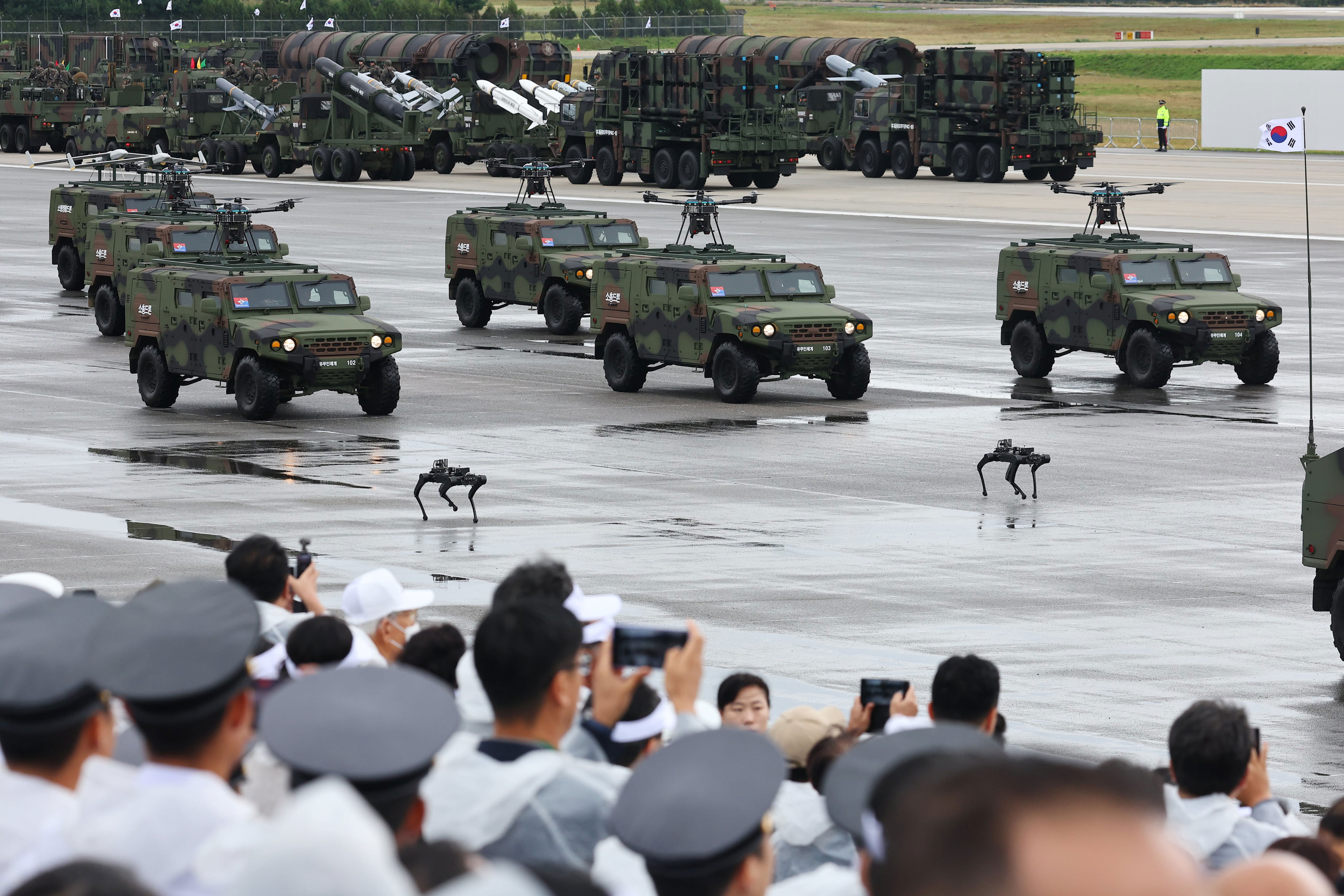
South Korea has been making significant strides in military technology, with a focus on integrating advanced systems into its defense strategies. Last year’s Armed Forces Day ceremony highlighted one such innovation—a quadrupedal robot resembling a dog. Unlike traditional unmanned and manned weapon systems that rely on vehicles for mobility, this robot was the only one to walk on legs during the parade. Developed under the Defense Innovation 4.0 rapid research program, it is designed for counter-terrorism operations. The robot can move at speeds exceeding 4 km/h and is capable of climbing vertical obstacles, such as stairs up to 20 cm high.
Equipped with a camera, the robot can perform surveillance and reconnaissance missions. It also reportedly has a remote-controlled shooting function capable of firing a handgun. Piloted by the Army Special Warfare Command and frontline divisions last year, the robot generated high expectations. However, a military source noted that even after charging the battery, the robot lasts less than two hours, which currently makes actual deployment unfeasible.
President Lee Jae-myung emphasized the need for the Republic of Korea’s military to evolve beyond a past-oriented force reliant on conscripted manpower. He stated that the military should be reorganized into a smart, elite, and specialized force equipped with a manned-unmanned complex system. According to him, with 50 personnel armed with AI combat robots capable of detecting, judging, aiming, and firing, along with armed autonomous drones and ultra-precision attack and defense missiles, the military could effectively handle not just 100 enemies, but even thousands or tens of thousands.
The government is also investing in quantum weapon systems that utilize cutting-edge quantum technology. Additionally, an “anti-drone hard-kill close-in defense system” is being developed to intercept enemy kamikaze drones using AI assistance. This technology is expected to enable hacking into enemy communication networks while simultaneously blocking their attempts to hack. Research is also underway to detect stealth fighters hundreds of kilometers away using quantum radar. A surveillance system to monitor North Korean troop movements in the Demilitarized Zone is reportedly in development.
Despite these advancements, concerns persist about the feasibility of such ambitious projects. Many experts argue that South Korea’s current quantum and AI technology levels remain in the early stages compared to countries like the U.S., Israel, and China. Jeong Kyung-woon, a senior research fellow at the Korea Strategic Studies Institute, pointed out that advanced countries are already using AI weapons in actual combat. He emphasized the importance of sharing AI warfare experiences with allied nations like the U.S. to stay competitive in the evolving global military landscape.
As South Korea continues to push the boundaries of military technology, the balance between innovation and practicality remains a critical challenge. While the potential of AI, robotics, and quantum technology is vast, translating these concepts into effective and reliable systems will require sustained investment, collaboration, and real-world testing. The journey toward a smarter, more agile military is ongoing, with each step bringing new opportunities and challenges.


Comments
Post a Comment